Green Energy and Sustainability ISSN 2771-1641
Green Energy and Sustainability 2026;6(2):0006 | https://doi.org/10.47248/ges2606020006
Original Research Open Access
Liquid hydrogen fuel system design for sustainable aviation applications
Vasilis Karaiskos
1
 ,
Konstantinos Fotis
1,2
,
Zinon Vlahostergios
1,2
,
Dimitrios Misirlis
1,3
,
Kyros Yakinthos
1
,
Konstantinos Fotis
1,2
,
Zinon Vlahostergios
1,2
,
Dimitrios Misirlis
1,3
,
Kyros Yakinthos
1
Correspondence: Vasilis Karaiskos
Academic Editor(s): Tony Roskilly, Georgios Martinopoulos, Georgia Kastrinaki, Hande Eryilmaz, Martin Roeb
Received: Oct 31, 2025 | Accepted: Apr 28, 2026 | Published: May 20, 2026
This article belongs to the Special Issue Selected Papers from the Conference ICRES 2025
Cite this article: Karaiskos V, Fotis K, Vlahostergios Z, Misirlis D, Yakinthos K. Liquid hydrogen fuel system design for sustainable aviation applications. Green Energy Sustain. 2026;6(2):0006. https://doi.org/10.47248/ges2606020006
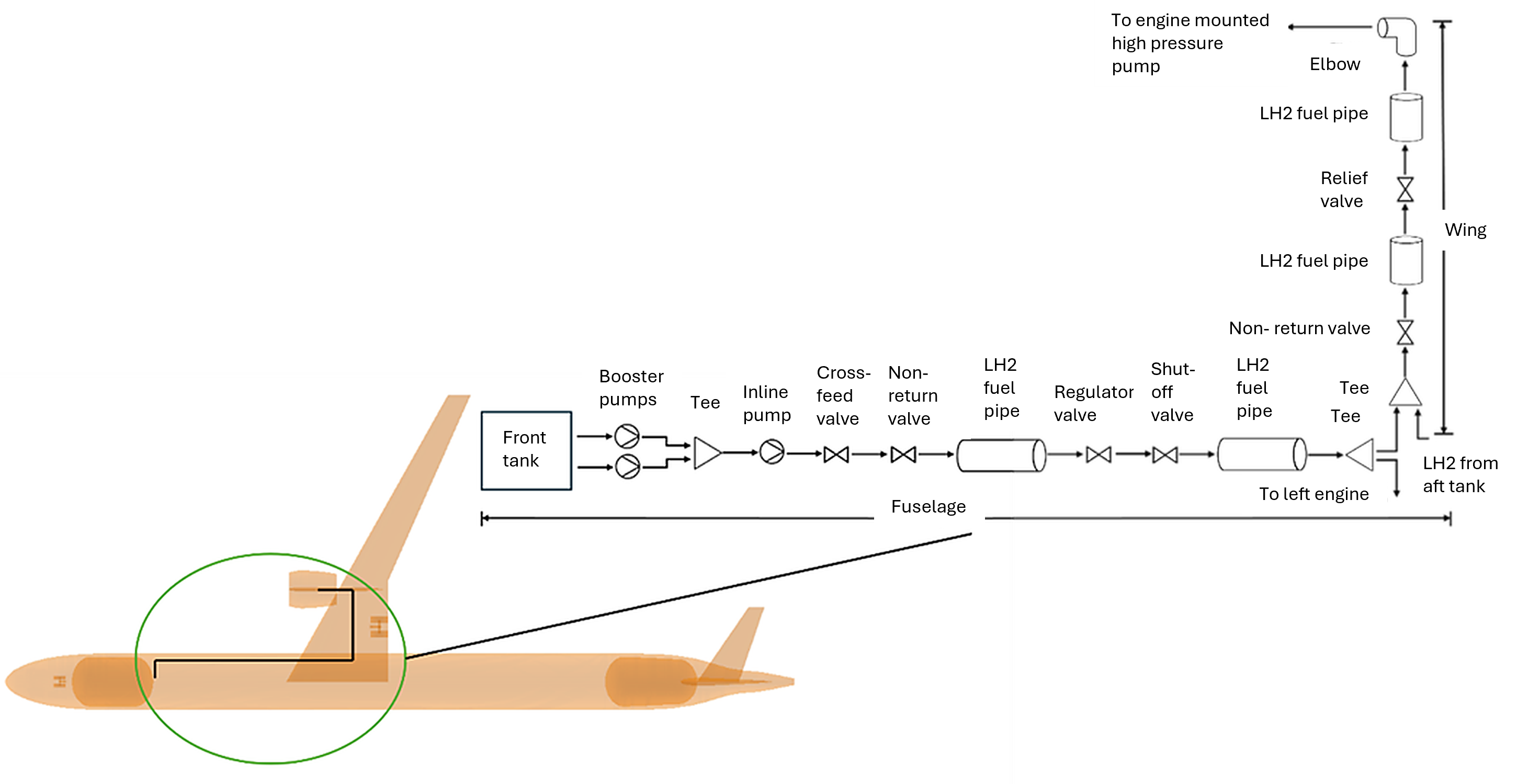
The growing interest in sustainable aviation has highlighted liquid hydrogen (LH2) as a promising alternative to conventional fuels. This study develops a systems level, conceptual approach to size and assess the key elements of an LH2 fuel system for a short-range commercial aircraft with operational and geometric characteristics similar to those of the Airbus A220-300. A configuration with two fuselage mounted tanks (front and aft), providing a total fuel capacity of approximately 4 t of LH2, is considered. A modeling framework is developed by coupling a tank sizing model with a one-dimensional distribution system model to evaluate key physical phenomena influencing system performance, including pressure losses, thermal behavior and overall weight impact, along the fuel path from the storage tanks to the engine interfaces under steady operating conditions. The architecture reflects typical safety and redundancy requirements for hydrogen systems, while remaining sufficiently simple to serve as a preliminary, low fidelity sizing tool at conceptual design level. The predicted fuel system mass is compared against several empirical mass correlations from the literature, providing an initial consistency check for the modelled architecture. The resulting framework provides a structured, low fidelity methodology for assessing LH2 storage and main distribution architectures and for identifying key design drivers and tradeoffs relevant to aircraft level integration.
Keywordshydrogen fuel, aviation, sustainable aviation, fuel distribution system, aerospace engineering, liquid hydrogen, cryogenic systems
Share this article




Copyright © 2026 Pivot Science Publications Corp. - unless otherwise stated | Terms and Conditions | Privacy Policy